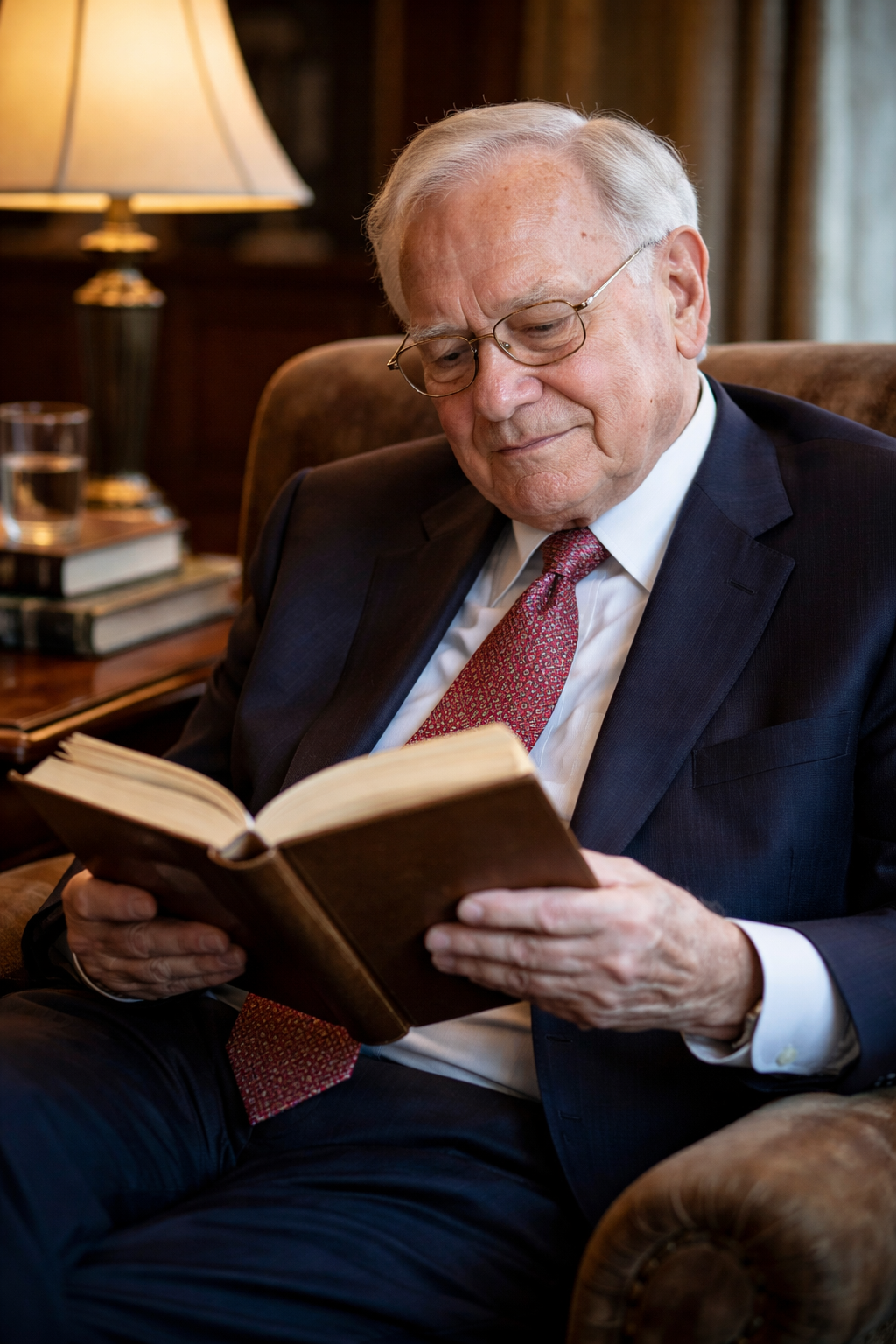
Few habits have had as profound an impact on personal and professional success as the daily reading routine practiced by Warren Buffett. Widely regarded as one of the most successful investors of all time, Buffett attributes a significant portion of his clarity, decision-making ability, and long-term success to reading. His approach to reading is not about speed or trends, but about depth, consistency, and intentional learning. Understanding how this habit works and how it can be applied to everyday life reveals a powerful path toward personal transformation.
Warren Buffett has often stated that he spends the majority of his day reading. This practice allows him to continuously expand his knowledge, refine his thinking, and make better decisions over time. What makes his reading habit so impactful is not just the volume of material, but the mindset behind it. Reading becomes a tool for compounding knowledge, much like investing compounds capital.
The Philosophy Behind Buffett’s Reading Habit
At the core of Buffett’s reading habit is the belief that knowledge accumulates gradually. He frequently compares learning to compound interest, where small, consistent efforts lead to exponential results over the long term. This philosophy removes the pressure of immediate results and emphasizes patience and persistence.
Rather than chasing quick insights or surface-level information, Buffett focuses on building a deep understanding of businesses, markets, and human behavior. This approach highlights the value of reading as a long-term investment in oneself rather than a short-term productivity tactic.
Adopting this mindset transforms reading from a passive activity into an intentional practice of self-development.
Consistency Over Intensity
One of the most important lessons from Buffett’s reading habit is the emphasis on consistency. He reads every day, regardless of market conditions or external distractions. This regularity ensures continuous learning and mental sharpness.
Many people attempt to read intensively for short periods but struggle to maintain the habit. Buffett’s example demonstrates that daily reading, even in manageable amounts, creates momentum and builds discipline. Over time, this consistency leads to a vast accumulation of knowledge.
Consistency also reduces resistance. When reading becomes a daily routine, it no longer requires motivation. It becomes a natural part of the day.
Reading as a Tool for Better Decision-Making
Reading improves decision-making by expanding perspective and reducing emotional bias. Buffett’s investment strategy relies heavily on rational analysis and long-term thinking, both of which are strengthened through extensive reading.
Exposure to diverse ideas, historical patterns, and different viewpoints allows readers to recognize recurring themes and avoid common mistakes. This broader perspective supports more informed and balanced decisions, not only in finance but in personal and professional life.
By regularly consuming high-quality information, individuals train their minds to evaluate situations logically rather than react impulsively.
Deep Reading and Focused Thinking
Buffett is known for engaging in deep, uninterrupted reading. This level of focus contrasts sharply with modern consumption habits dominated by short-form content and constant distractions. Deep reading strengthens concentration and critical thinking.
Focused reading encourages comprehension rather than skimming. It allows ideas to be fully absorbed and connected to existing knowledge. This depth of understanding is what enables long-term insight and wisdom.
Practicing deep reading also improves attention span, which has become a valuable skill in an increasingly fragmented digital environment.
The Compounding Effect of Knowledge
One of the most transformative aspects of Buffett’s reading habit is the compounding effect of knowledge. Each new piece of information builds upon what was learned before, creating a network of understanding that grows stronger over time.
This compounding effect applies to all areas of life. Reading about psychology improves relationships, reading about health supports well-being, and reading about business enhances career opportunities. The benefits multiply as knowledge intersects across disciplines.
Unlike material possessions, knowledge compounds indefinitely and cannot be taken away.
Developing Independent Thinking Through Reading
Reading widely helps develop independent thinking, a trait Warren Buffett values highly. By studying original sources, financial reports, and long-form analysis, he forms his own conclusions rather than relying on popular opinion.
This habit encourages intellectual independence and reduces susceptibility to trends, hype, and external pressure. Independent thinking fosters confidence and clarity, enabling individuals to act based on understanding rather than emotion.
Through reading, individuals gain the tools to question assumptions and think critically about the world around them.
Applying Buffett’s Reading Habit to Everyday Life
While few people can dedicate entire days to reading, the principles behind Buffett’s habit are accessible to anyone. The key is intentionality. Choosing high-quality material and committing to daily reading creates meaningful progress.
It is important to prioritize substance over volume. Reading fewer books deeply is often more valuable than consuming many superficially. Taking time to reflect on what is read enhances retention and application.
Integrating reading into daily routines, such as mornings or evenings, increases consistency and reduces friction.
What to Read for Maximum Impact
Buffett’s reading typically focuses on areas that build long-term understanding rather than short-term entertainment. This includes business fundamentals, biographies, history, psychology, and economics.
These subjects provide context, patterns, and lessons that remain relevant over time. Reading biographies, in particular, offers insight into decision-making, resilience, and character development.
Choosing timeless content ensures that reading efforts continue to provide value long after the initial exposure.
Reading as a Form of Self-Discipline
Maintaining a daily reading habit requires discipline, especially in a world full of distractions. Buffett’s example demonstrates that discipline is not about restriction, but about prioritization.
Reading becomes an act of self-respect and long-term thinking. It reflects a commitment to growth rather than immediate gratification.
Over time, this discipline extends to other areas of life, reinforcing positive habits and intentional living.
The Transformational Impact of a Reading Habit
Adopting a reading habit inspired by Warren Buffett can lead to profound personal transformation. It enhances clarity, patience, and confidence while reducing impulsive behavior and emotional decision-making.
Reading strengthens the ability to think long-term, understand complexity, and navigate uncertainty. These skills are invaluable in both personal development and professional success.
Ultimately, Buffett’s reading habit demonstrates that consistent learning is one of the most powerful investments a person can make. By embracing reading as a daily practice, individuals create a foundation for lifelong growth, wisdom, and self-improvement.